
Should You Repair or Replace Your Furnace
A furnace problem does not always mean you need a new heating system. In many homes, a simple repair, filter change, thermostat correction, or annual tune-up can restore reliable heat. The smarter decision comes from comparing the age of the equipment, the seriousness of the failure, furnace repair costs, comfort problems, safety risks, and the long-term value of energy-efficient heating.
Should You Repair or Replace Your Furnace?
You should usually repair your furnace when the system is relatively young, the problem is isolated, comfort is otherwise consistent, and the repair cost is modest compared with replacement. You should seriously consider replacement when the furnace is old, needs frequent service, has a cracked heat exchanger, struggles to heat the home, or is pushing energy bills higher despite proper maintenance. ENERGY STAR notes that certain warning signs can indicate it is time to replace heating and cooling equipment. (energystar.gov)
A helpful way to think about the choice is this: a repair buys more time, while replacement resets the clock. If the furnace still has years of reasonable life left, a targeted repair can be the most practical home heating solution. If the system is nearing the end of its service life and every winter brings a new breakdown, continuing to repair it can become a slow, expensive path toward the replacement you may need anyway.
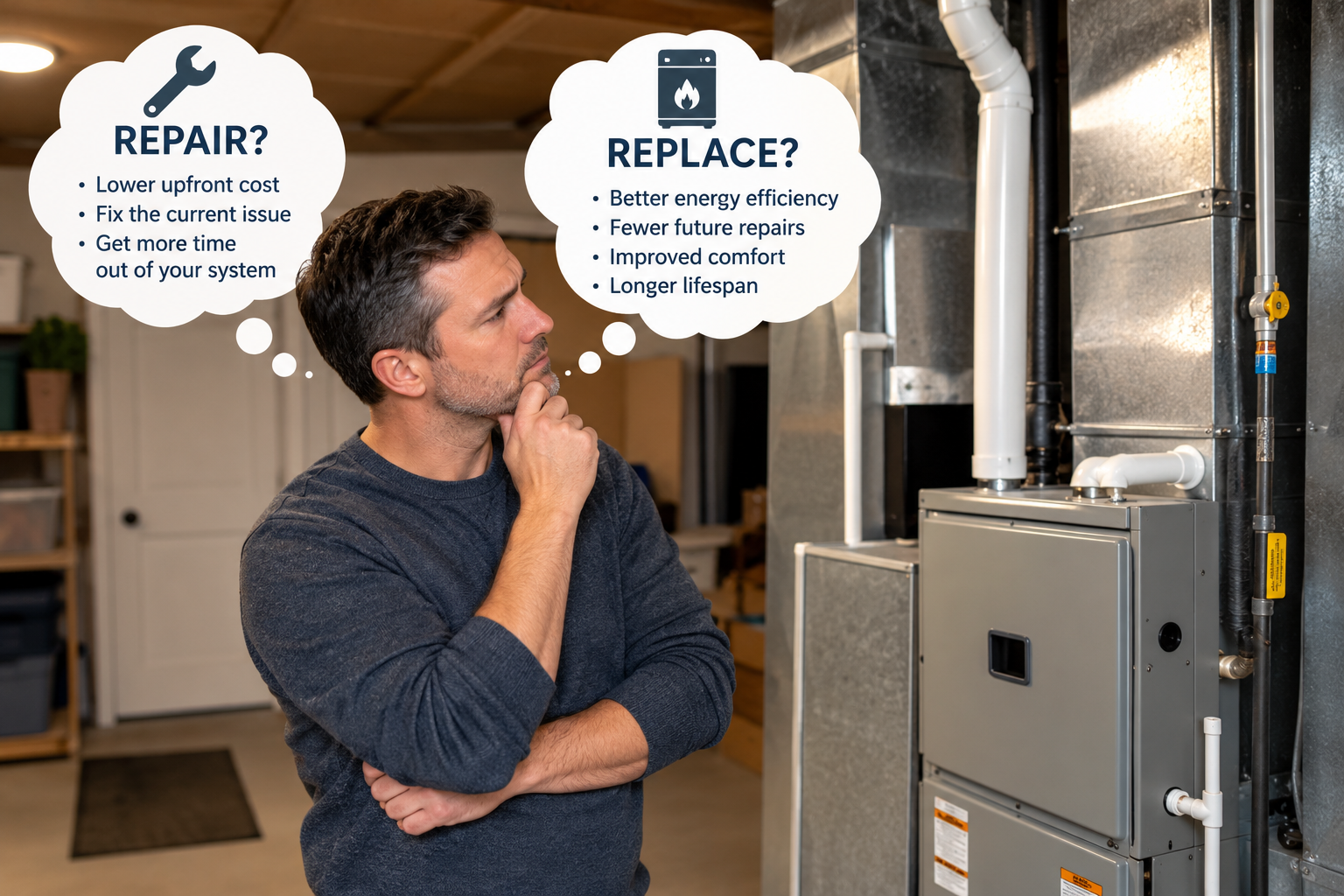
The main factors that shape the decision
No single rule works for every home because furnaces fail in different ways. A worn ignitor, dirty flame sensor, clogged filter, or faulty thermostat can be inexpensive compared with a major internal failure. But repeated service calls, rising utility bills, uneven heating, and safety concerns all change the math.
Use the following factors together rather than in isolation:
- Age of the furnace: An older unit is less likely to justify a major repair, especially if other components are also wearing out.
- Repair history: One repair may be normal; recurring repairs suggest the system is becoming unreliable.
- Type of problem: Electrical, ignition, sensor, and airflow issues are often different decisions than heat exchanger or combustion problems.
- Energy use: A lower-efficiency furnace can cost more to operate over time, especially in cold climates.
- Comfort performance: Rooms that are too cold, noisy operation, short cycling, or weak airflow may point to system or ductwork issues.
- Safety: Any sign of carbon monoxide, gas odor, cracked combustion components, or flame rollout requires immediate professional attention.
This is where a professional diagnosis matters. A good technician should explain what failed, why it failed, whether the issue is isolated, and what other risks are visible. That information helps you avoid both unnecessary replacement and repeated patchwork repairs.
A practical furnace troubleshooting guide before you call
Some furnace issues start with simple causes that homeowners can safely check. This furnace troubleshooting guide is not a substitute for licensed service, but it can help you rule out basic problems before paying for a visit. Stop immediately and call a professional if you smell gas, suspect carbon monoxide, see burn marks, hear unusual combustion sounds, or feel unsafe.
Before scheduling service, check these items:
- Thermostat settings: Confirm the system is set to heat, the temperature is above room temperature, and the batteries are fresh if the thermostat uses them.
- Air filter: A dirty filter can restrict airflow, cause overheating, reduce comfort, and make the furnace shut down early. Regular heating and cooling maintenance is necessary to prevent future problems and unwanted costs.
- Breaker and power switch: Make sure the furnace switch is on and the electrical breaker has not tripped.
- Vents and returns: Open supply vents, keep returns clear, and remove furniture or rugs blocking airflow.
- Condensate line: High-efficiency furnaces can shut down if a condensate drain is clogged.
- Flame or error code: Some furnaces display a blinking diagnostic code. Write it down before resetting the unit so a technician has useful information.
If these checks do not solve the problem, avoid repeatedly resetting the system. Frequent resets can hide symptoms and may allow an unsafe condition to continue. A trained HVAC technician can test combustion, airflow, electrical components, gas pressure, venting, and safety controls in a way a homeowner cannot.
When repair makes the most sense
Repair is usually the better choice when the furnace has a clear, limited problem and the rest of the system is in good condition. If the unit has heated the home reliably, the repair is affordable, and the technician does not find broader wear or safety concerns, fixing it can extend useful life without forcing a large investment.
Common repair-friendly situations include a failed ignitor, dirty flame sensor, worn blower capacitor, thermostat issue, loose wiring connection, or clogged drain line. These problems can feel dramatic because the furnace may stop heating altogether, but they do not always mean the system is failing as a whole. Current 2026 Angi data places the national average furnace repair cost at about $448 CAD, though actual costs vary by part, labor, location, system type, and urgency. (angi.com)
Repair can also make sense if you are planning other home improvements soon. For example, if you expect to upgrade insulation, seal ducts, or remodel, a short-term repair may give you time to make a better whole-home decision. Just be careful not to spend heavily on a system that is already showing multiple signs of decline.
When replacement becomes the smarter investment
Replacement becomes more compelling when repairs are expensive, the furnace is aging, or the system no longer meets the home’s comfort needs. It is also the safer path when a major component failure creates combustion or carbon monoxide concerns. In those cases, the question is not only “Can it be repaired?” but “Should this system continue operating?”
Consider replacement if you notice several of these patterns:
- Repairs are becoming more frequent or more expensive.
- The furnace runs constantly but still leaves rooms cold.
- Energy bills are rising without a clear change in weather or usage.
- The system short cycles, bangs, rattles, or produces uneven airflow.
- A technician finds a cracked heat exchanger or serious venting problem.
- The furnace is poorly sized for the home or was installed incorrectly.
- You want better compatibility with energy-efficient heating upgrades, zoning, or a heat pump.
A new furnace may also improve comfort in ways a repair cannot. Modern equipment can offer better efficiency, quieter operation, improved blower performance, and more consistent heating when properly sized and installed. ENERGY STAR explains that AFUE measures how much heat a furnace delivers compared with the fuel it consumes, which is why efficiency ratings matter when comparing replacement options. (energy.gov)
The cost question: repair price versus long-term value
Furnace repair costs should be judged against the remaining value of the system. A low-cost repair on a dependable unit is usually reasonable. A costly repair on an old, inefficient, or unreliable unit deserves more scrutiny because it may only delay a replacement by a short period.
A simple decision framework can help:
| Situation | Better leaning | Why it matters |
|---|---|---|
| Minor part failure on a well-maintained furnace | Repair | The issue is likely isolated and the system still has practical value. |
| Major repair plus repeated breakdowns | Replace | The repair may not solve the broader reliability problem. |
| Uneven heat caused by airflow or duct issues | Diagnose first | Replacing the furnace alone may not fix duct or distribution problems. |
| High bills with an older low-efficiency unit | Compare replacement | Energy-efficient heating may reduce operating waste over time. |
| Safety-related failure | Replace or major professional correction | Safety should outweigh short-term savings. |
Do not compare only today’s invoice. Compare repair cost, expected future service, energy use, comfort, warranty coverage, and the risk of losing heat during severe weather. If replacement is on the table, ask for a load calculation rather than assuming the new furnace should be the same size as the old one.
Energy-efficient heating changes the equation
Efficiency matters because the cheapest repair today is not always the lowest-cost choice over several winters. ENERGY STAR-certified furnaces have higher AFUE ratings and efficient blower motors, and qualified furnaces can be more efficient than conventional models. (energystar.gov)
For the best result, think in systems: furnace, thermostat, ducts, insulation, air sealing, ventilation, and maintenance. This approach can help you choose home heating solutions that improve comfort instead of simply replacing one metal box with another.
Furnace maintenance tips that protect either choice
Whether you repair or replace furnace equipment, maintenance determines how well it performs. A neglected new furnace can develop problems early, while a well-maintained existing furnace may run more reliably than expected.
Use these furnace maintenance tips as a seasonal routine:
- Replace or clean filters regularly according to the filter type, household dust levels, pets, and system use.
- Schedule professional maintenance before the main heating season so ignition, combustion, electrical, and safety components can be checked.
- Keep vents and returns open to prevent airflow restrictions and comfort problems.
- Listen for changes such as grinding, rattling, booming, or frequent cycling.
- Check thermostat programming so the furnace is not overworking when the home is empty or asleep.
- Keep the furnace area clear of storage, chemicals, and flammable materials.
- Install and maintain carbon monoxide alarms near sleeping areas and according to manufacturer instructions.
Maintenance also creates documentation. If you eventually sell your home or file a warranty claim, service records can show that the system was cared for properly.
Questions to ask before approving work
Before you approve a repair or sign a replacement proposal, slow the process down enough to understand the recommendation. A reputable contractor should be willing to explain the diagnosis in plain language.
Ask these questions:
- What failed, and what caused it?
- Is this an isolated problem or part of a larger pattern?
- Are there any safety concerns?
- What is the total repair cost, including parts, labor, and diagnostic fees?
- How long is the repair expected to last?
- What other components show wear?
- What efficiency options are appropriate for this home and climate?
- What maintenance will the system need after the work is complete?
The answers should make the decision clearer, not more confusing. If the recommendation feels rushed, vague, or fear-based, getting a second opinion is reasonable.
The best decision balances safety, comfort, and timing
The right choice is not always the newest furnace or the cheapest repair. It is the option that gives your household safe, dependable heat at a sensible long-term cost. Repair is often wise for limited, affordable problems on a solid system; replacement is often wiser when age, efficiency, comfort, and reliability are all moving in the wrong direction.
If you’re unsure whether to repair or replace your furnace, contact Burlington Heating & Air Conditioning for a professional inspection and a written estimate for both options. With a clear diagnosis, realistic repair costs, and an understanding of your home’s heating needs, our team can help you make an informed decision with confidence—before the next cold-day breakdown.


